BlockBuster.
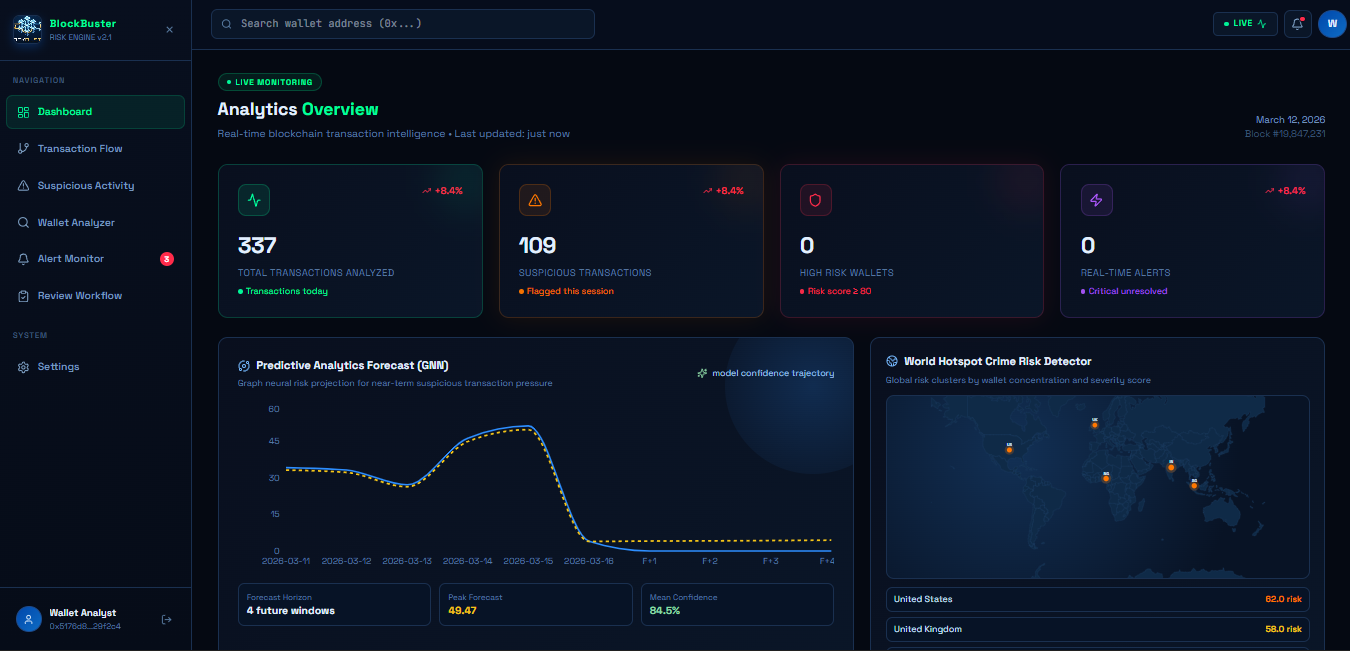
Blockchain forensics dashboard for suspicious wallet analysis
Problem, solution, and result.
A tighter story that reads like a real client case study.
Investigators need faster ways to spot risky wallet behavior and understand transaction networks without manual tracing.
A blockchain forensics workflow combining risk signals, visual analytics, and report-ready outputs for security review.
Faster investigations · Clearer wallet risk signals · Actionable alerting
A system designed to last.
Edge-native, observable and built for compounding velocity.
What was actually built.
A useful snapshot of the product and system behind the case study.
Investigators need faster ways to spot risky wallet behavior and understand transaction networks without manual tracing.
A blockchain forensics workflow combining risk signals, visual analytics, and report-ready outputs for security review.
A project-specific visual that anchors the story without relying on a generic category mockup.
- Suspicious wallet scoring
- Transaction flow visualization
- Review workflow
- Evidence-ready reporting
Crafted surface. Considered system.
Grouped so the product read feels intentional instead of crowded.
Core experience
- Suspicious wallet scoring
- Transaction flow visualization
Platform & systems
- Review workflow
- Evidence-ready reporting
Five movements. One outcome.
The work is easier to follow when each phase gets its own room.
Stakeholder interviews, market analysis, success metrics and a sharpened product thesis.
Information architecture, user journeys, technical constraints and a pragmatic roadmap.
Editorial visual system, motion language and prototype-driven product surface design.
Type-safe full-stack engineering with observability, performance budgets and CI from day one.
Phased rollout, telemetry, growth instrumentation and an always-on iteration cadence.
These are the actual technologies used in this project, not a curated shortlist.
Deeper entity clustering, automated case notes, and expanded threat intel feeds.